COMPANY SOLNHOFEN STONE GROUP
Efficient Production in the Altmühl Valley

In addition to SOLNHOFEN LIMESTONE, Solnhofen Stone Group extracts Jura limestone on a large scale from its own quarries. For processing, SSG relies on customised sawing, grinding and polishing technology from Burkhardt-Löffler.
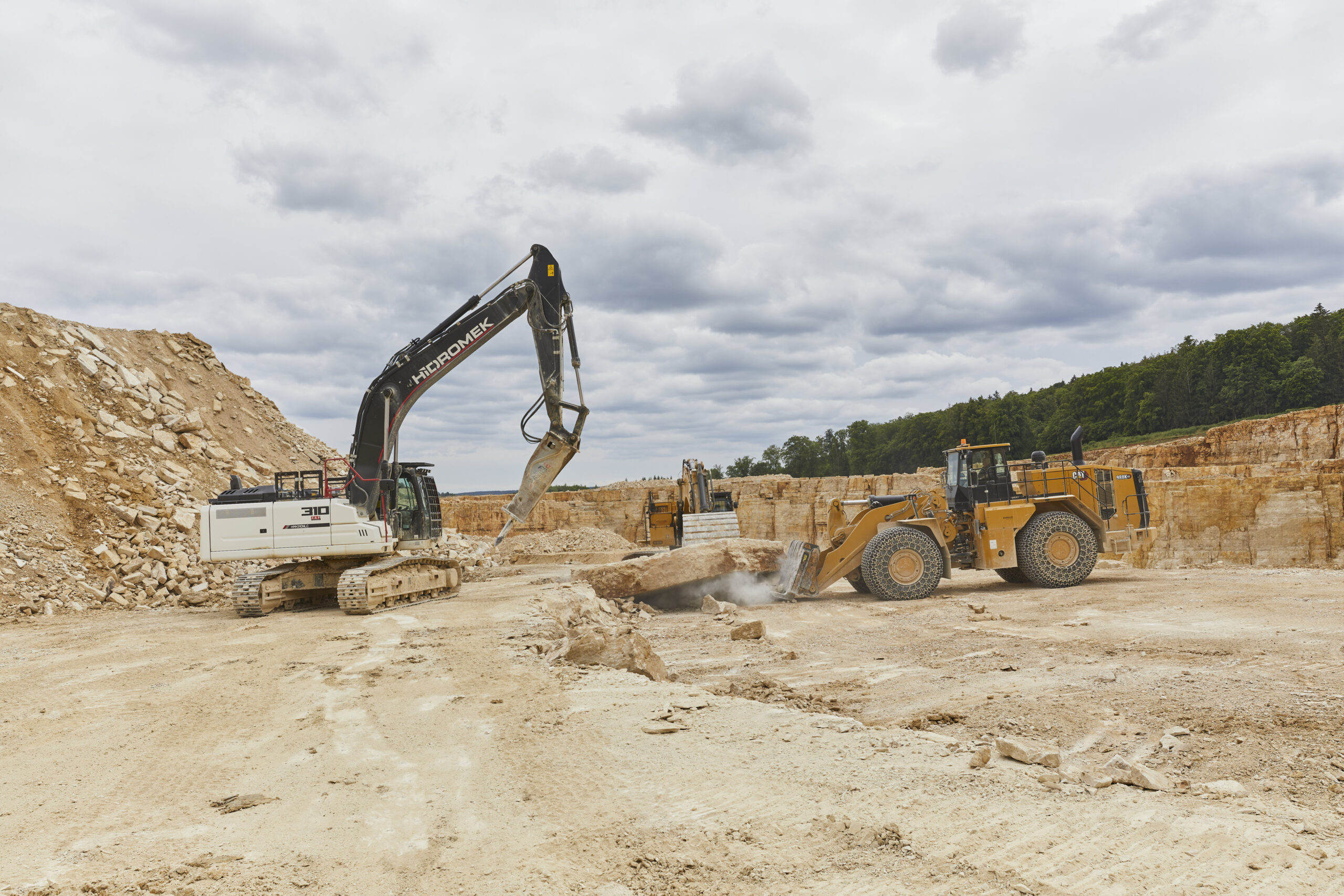
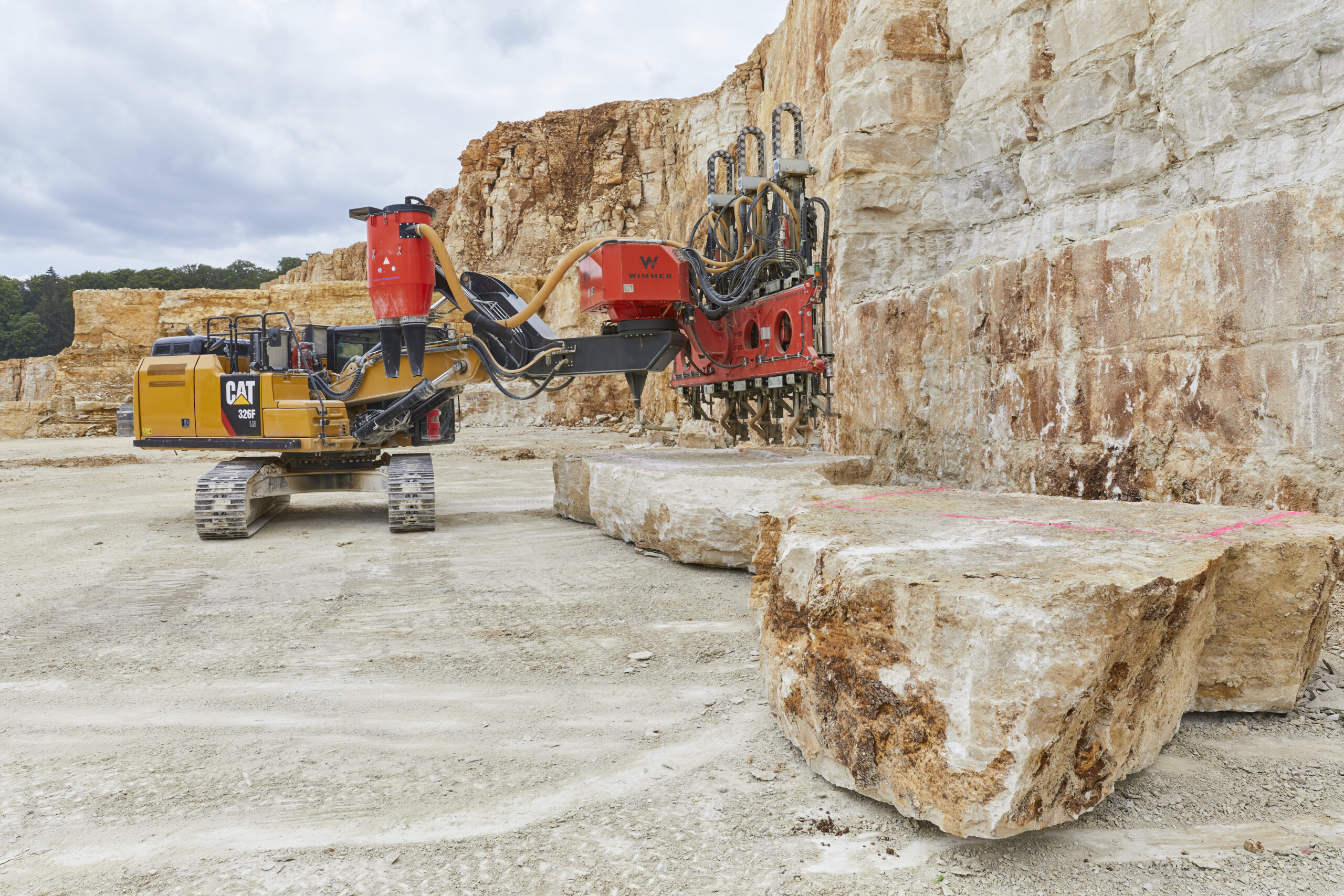
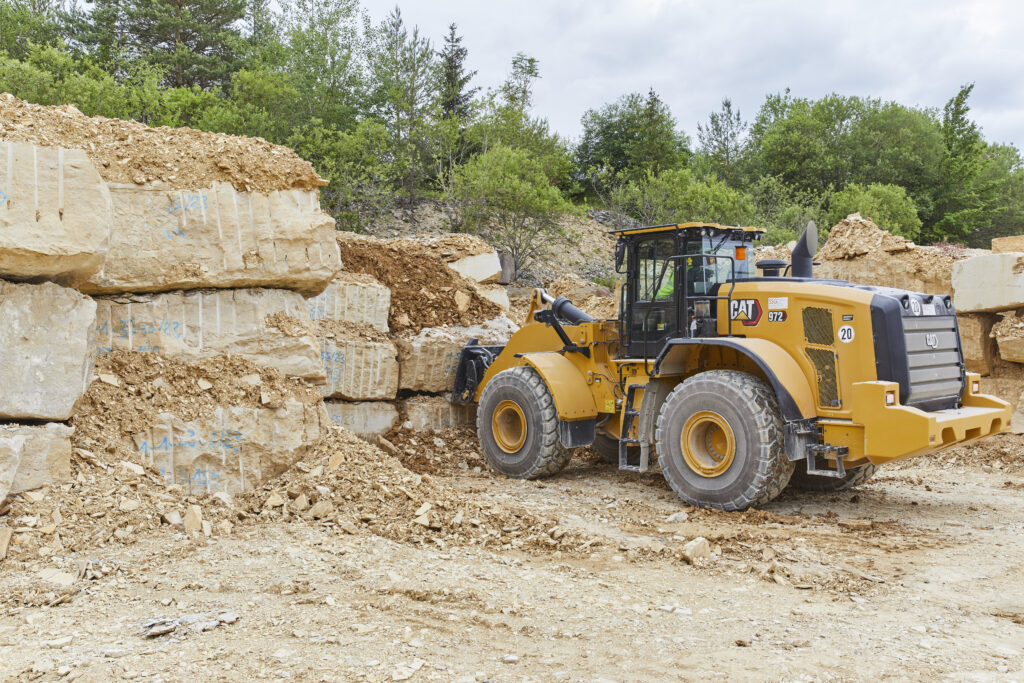
The quarry sites are only a proverbial stone’s throw apart, yet the two classic natural stones could hardly be more different. While the finely layered SOLNHOFEN LIMESTONE requires a high proportion of manual work during extraction and processing, SSG extracts the Jura limestone, which occurs in thicker beds, efficiently in blocks and processes it using state-of-the-art machinery. The largest of SSG’s three Jura limestone quarries is the Übermatzhofen quarry. Production Manager Roland Haaß explains that the company acquired it in the mid-1980s, when it was already an active quarry. Today, between 8,000 and 10,000 cubic metres are extracted annually for the production of finished stone products. Large volumes are also supplied to the gardening and landscaping sector. Material that cannot be used in either of these areas is sent to cement production, as SSG is a branch of Solnhofer Portland-Zementwerke GmbH & Co. KG. Only a certain quantity of material remains for backfilling areas that are no longer in use, helping the company comply with the strict environmental requirements governing quarry restoration.

Storage Protected from the Weather

Freshly quarried Jura limestone contains natural core moisture. While blocks intended for interior applications can be processed immediately when required, raw material extracted during the colder months and intended for exterior products is stored in underground bunkers or halls, protected from the weather and frost. Storage in the halls allows the core moisture to escape gradually. Once the moisture has dissipated, the stone is durable enough for applications such as façades. Depending on the porosity of the particular layer, this process generally takes only a few months. The blocks are then ready for the next processing stages.

The automatic drilling machine sizes the blocks, which range from 25 to 120 cm in thickness, to a maximum of 3.3 × 1.8 m for further processing.

Customised Technology

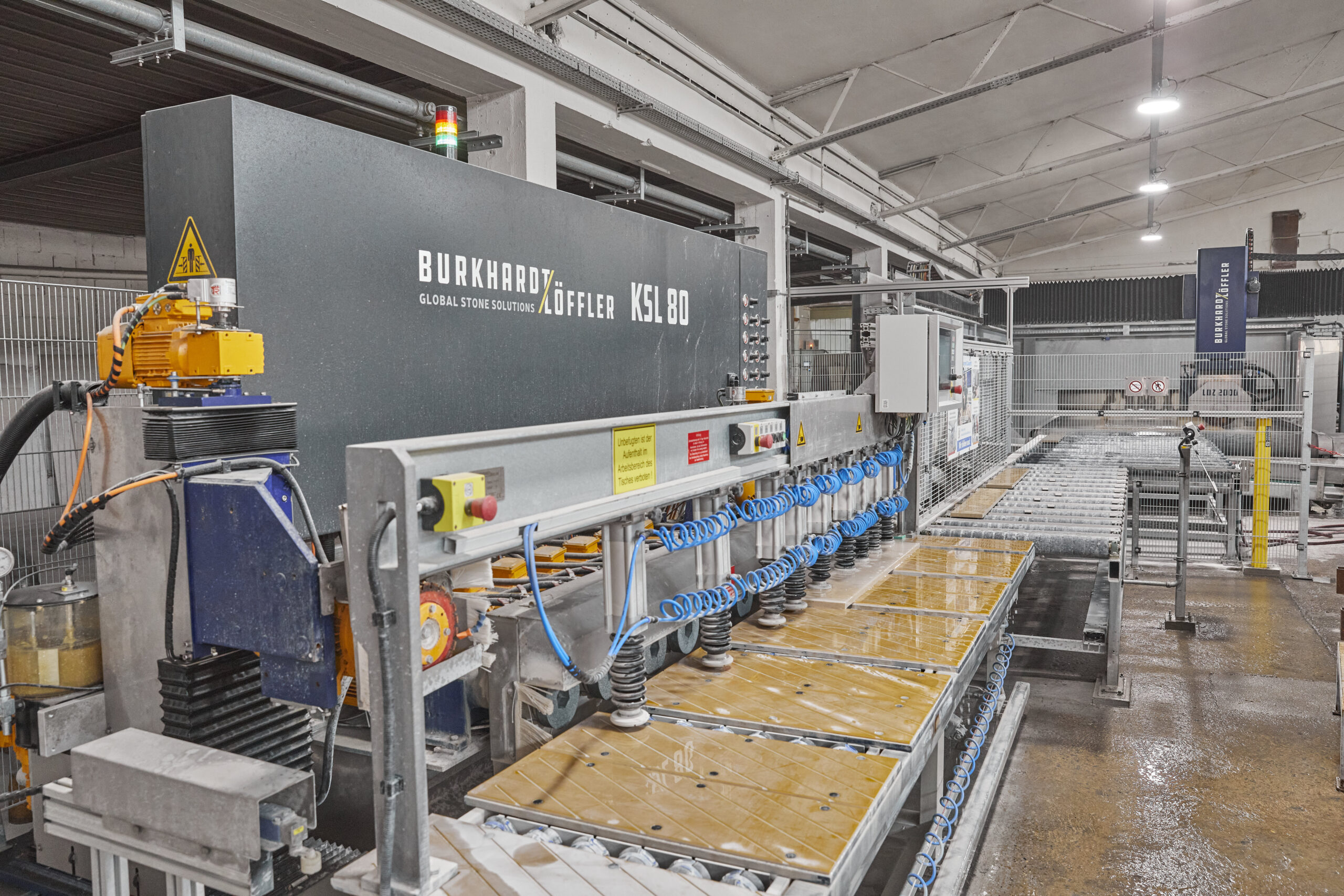
After the blocks have been cut into slabs in the primary sawing department, the rough slabs begin their journey through the modern production hall. As part of its continuous modernisation programme, SSG has relied on machinery from Burkhardt-Löffler for many years. To produce floor tiles, façade panels and kitchen worktops quickly and economically, an MLS/MKS saw line equipped with four sawing units on each machine was initially installed in 2014. This was followed in 2019 by an FR/FS 2000 grinding and polishing line.The most recent investments from Burkhardt-Löffler are a saw line installed in 2022, featuring two LDZ 2000 5-axis bridge saws with slab detection and a vacuum manipulator, as well as a KSL 80 table-design edge polisher. Several factors influenced the decision to select the German manufacturer. Although Burkhardt-Löffler’s factory in Langenaltheim is only a few minutes by car from the natural-stone plant, geographical proximity was not the only consideration. According to Roland Haaß, the decisive factors were above all the company’s expert advice and its high degree of flexibility when configuring the systems. Other important criteria for every investment include SSG’s many years of experience with the quality of the machines—a standard the company had already experienced much earlier with Burkhardt-Löffler’s predecessor, Löffler—as well as the rapid availability of spare parts, the Production Manager adds. Although every natural-stone plant presents machine manufacturers with its own particular challenges, increasing capacity and achieving the highest possible degree of automation were also at the top of SSG’s specifications. Lead times are becoming shorter, while recruiting personnel is becoming increasingly difficult.

Retrieved as required: Protected from frost, the blocks have spent the winter in the underground bunker.
Station for automatically loading rough slabs before calibration
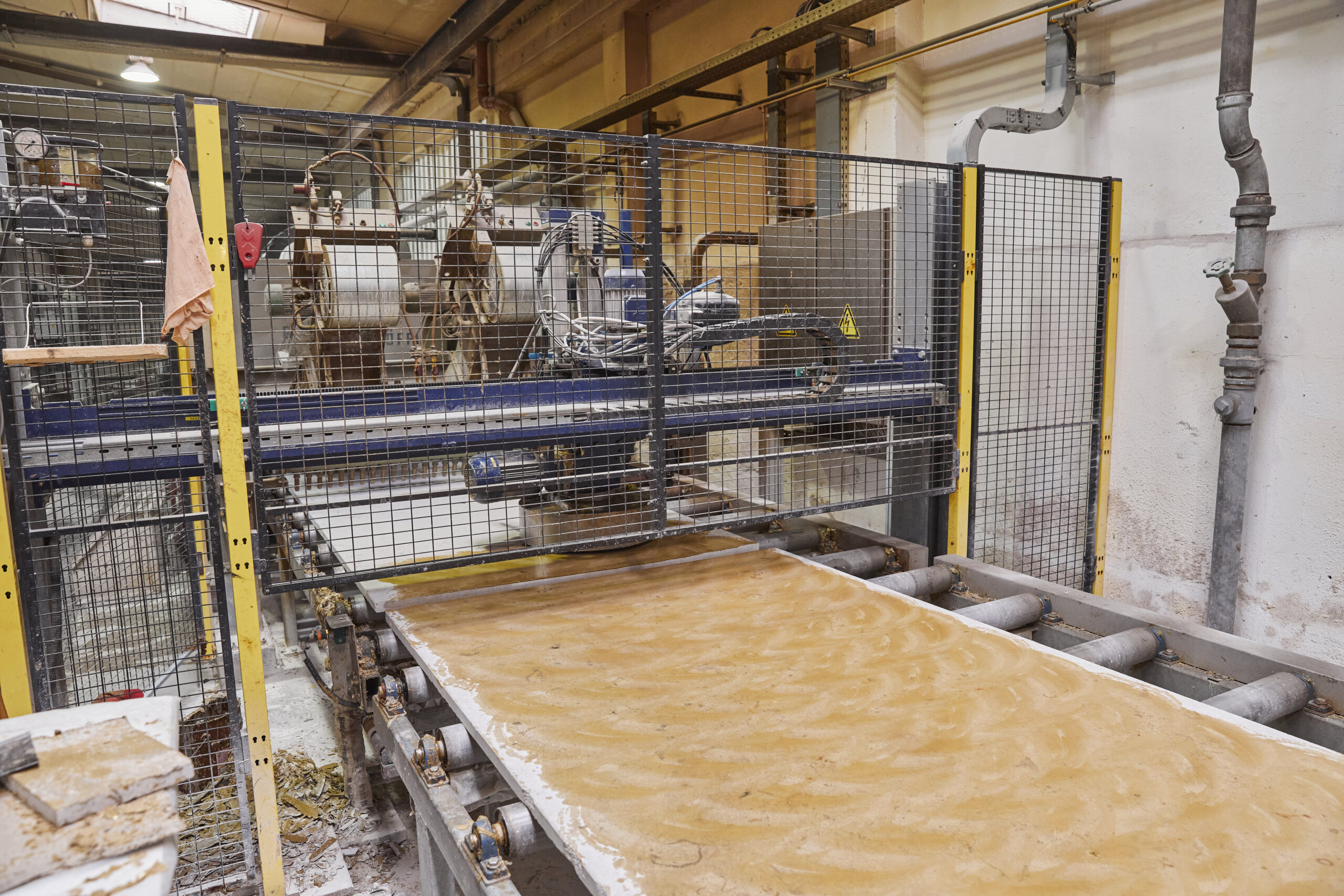
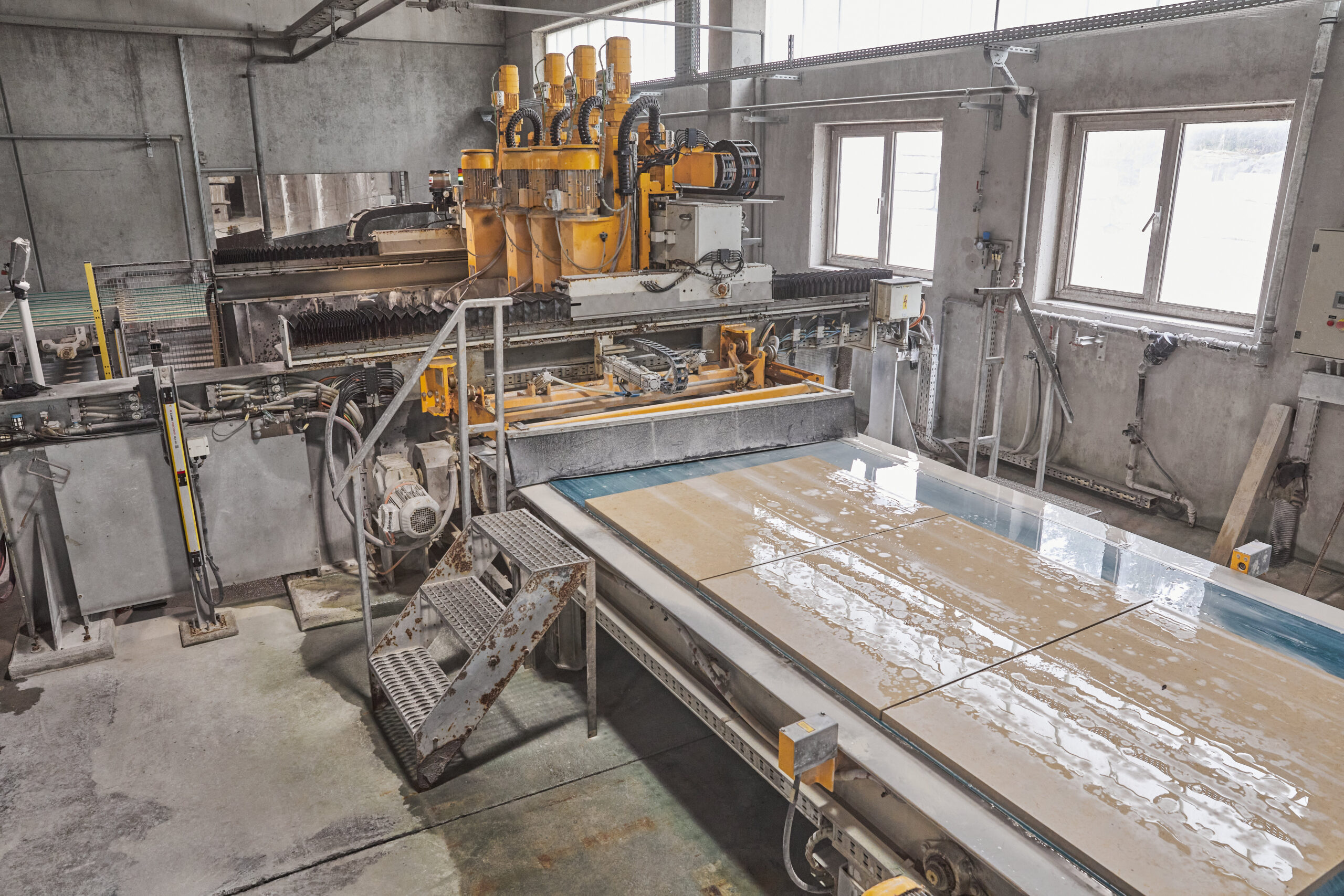
On the FR/FS 2000 grinding and polishing line: Before grinding, the calibrated slabs are resin-filled.
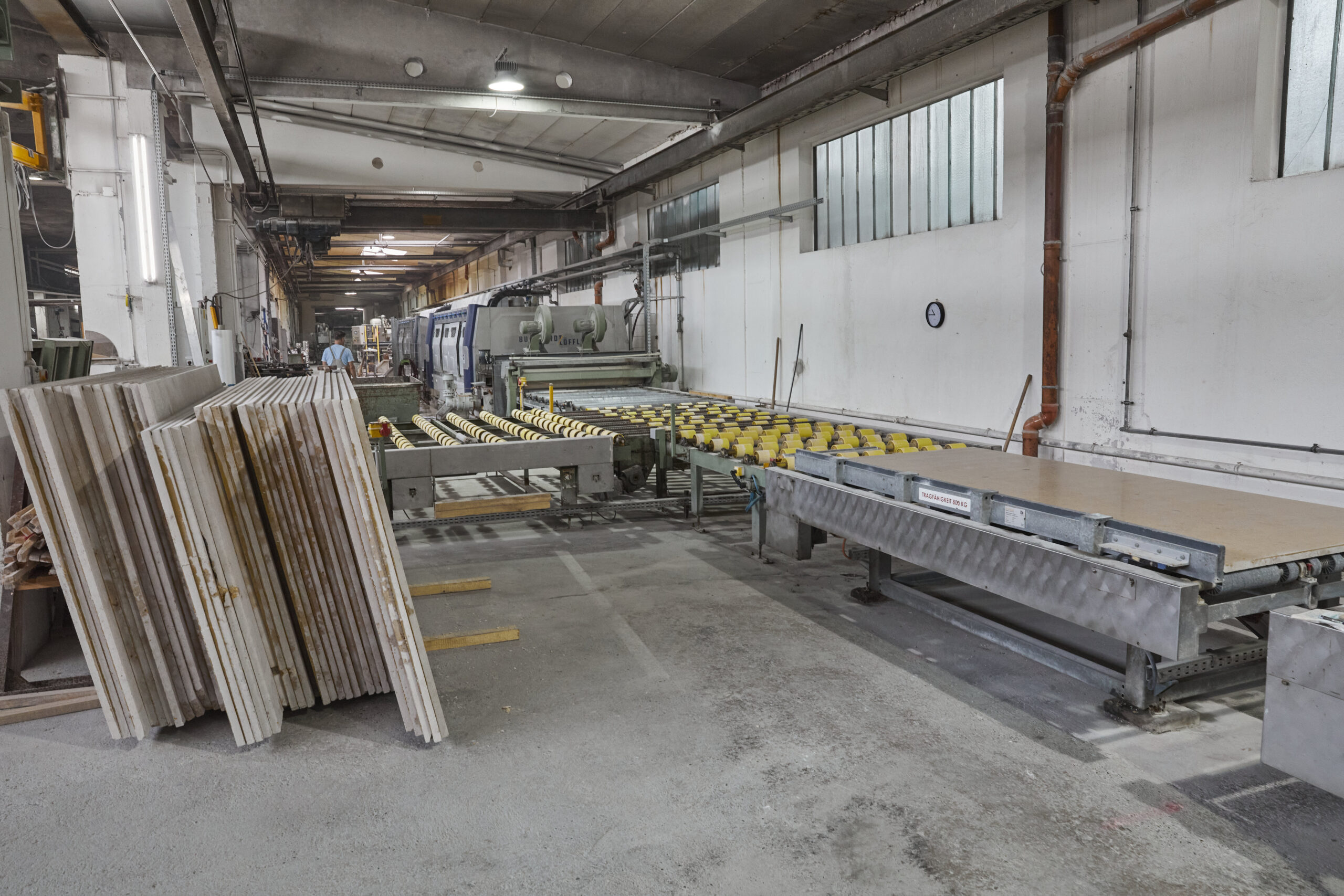
Just as important as the processing stations: Automated conveyor systems transport the workpieces from the grinding and polishing line to the longitudinal saw.
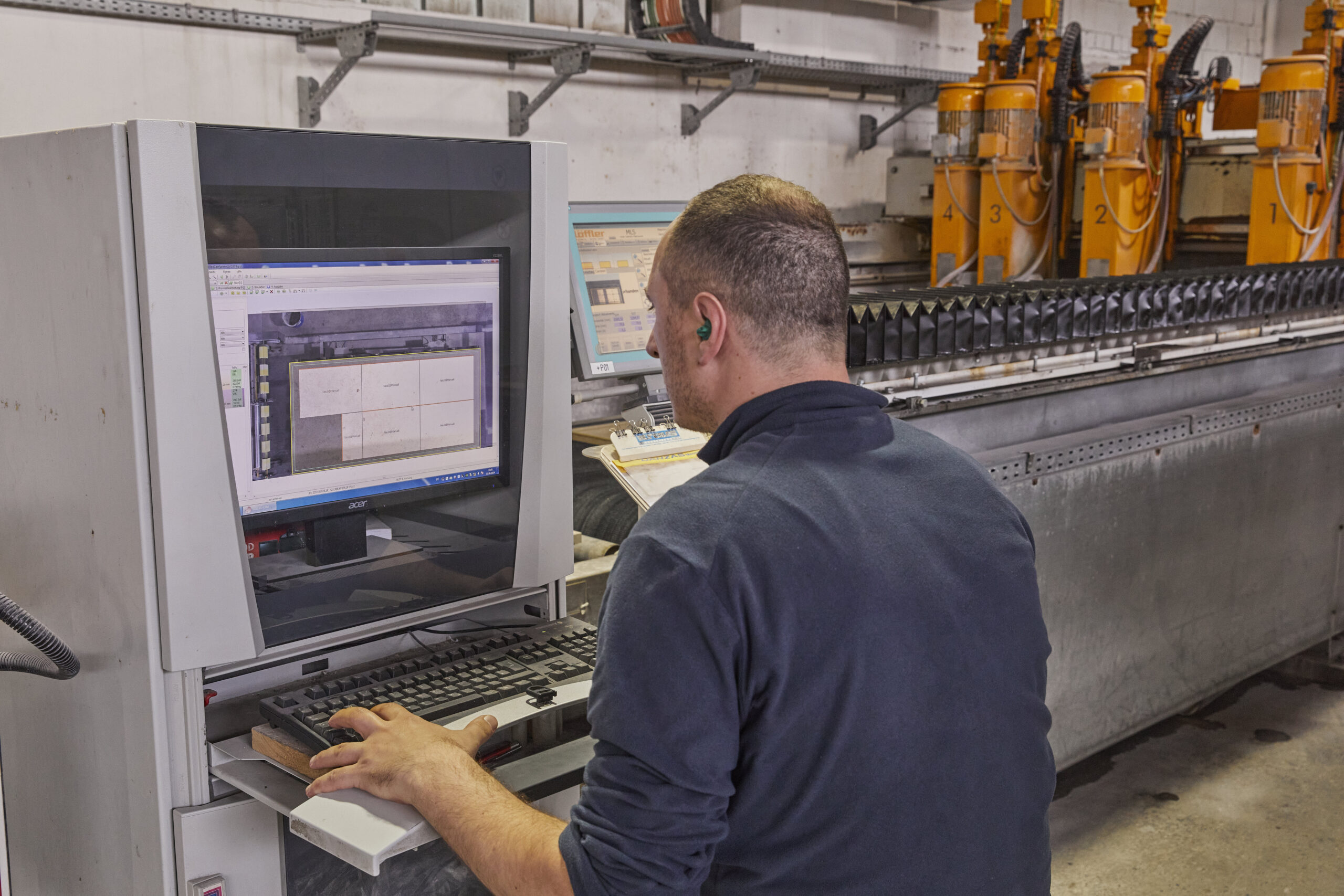
Upstream of the MLS/MKS saw line with four sawing units on each machine: The slab layout is prepared immediately before longitudinal cutting.
Thanks to the preceding slab-layout process, no further operator intervention is required at the cross-cut saw.
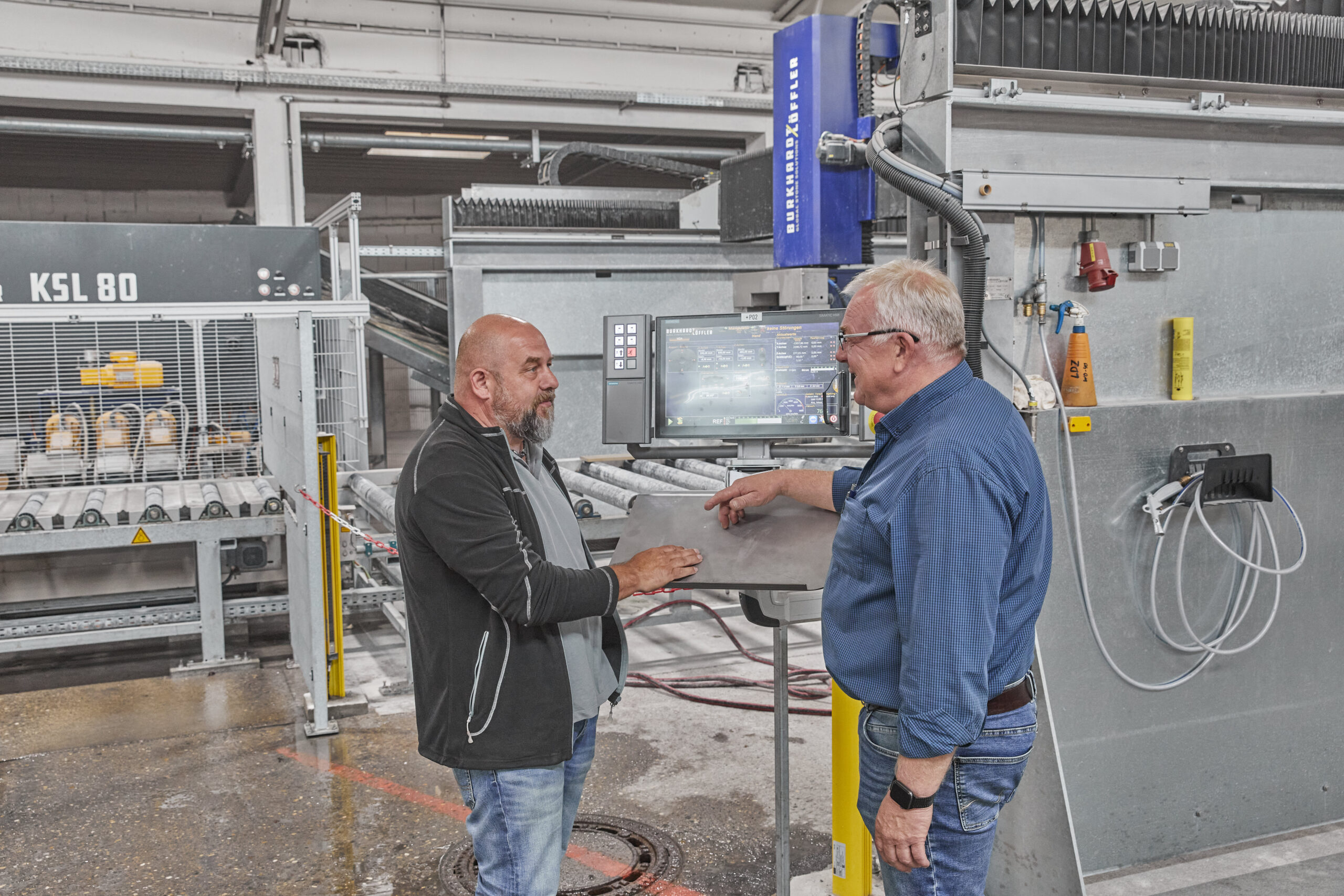
Always looking for further optimisation potential: SSG Production Manager Roland Haaß, left, and Thomas Straßner of Burkhardt-Löffler.

Investing for the Long Term

As with any company integrating new machinery into an existing production environment, the machines in Solnhofen had to be optimally adapted to the available space. The crucial factor in economical production is a smooth material flow between the individual stations. The less frequently employees have to move workpieces manually or by crane or forklift—from the provision of the raw material through to order picking and packaging—the more efficient the production process becomes.

On the grinding and polishing line, the rough slabs are first calibrated, automatically resin-filled and then ground. The multi-blade saw subsequently divides the slabs into window sills, floor tiles, façade panels and other rectangular products. Roller conveyors then transport the finished pieces directly to the order-picking area.

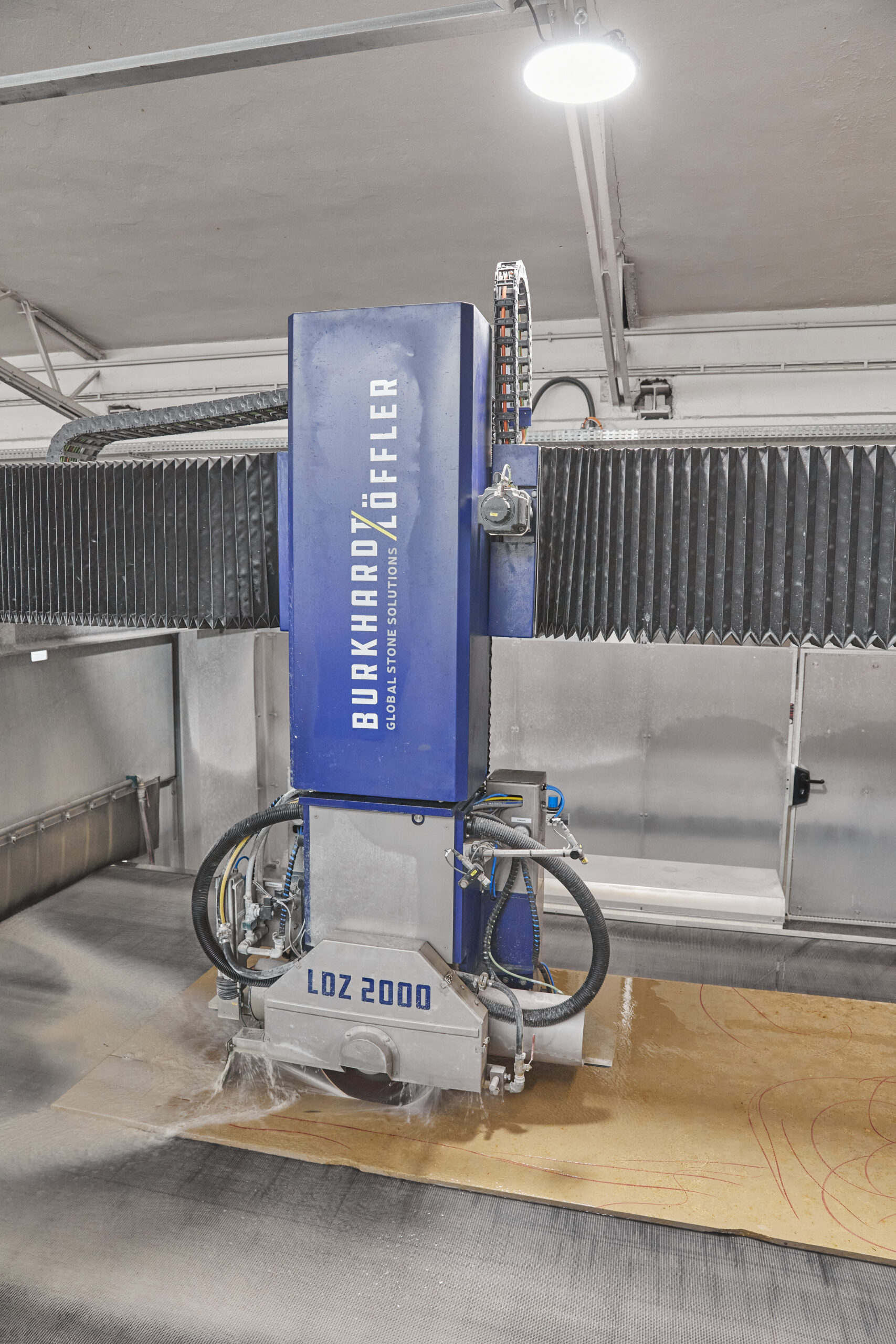
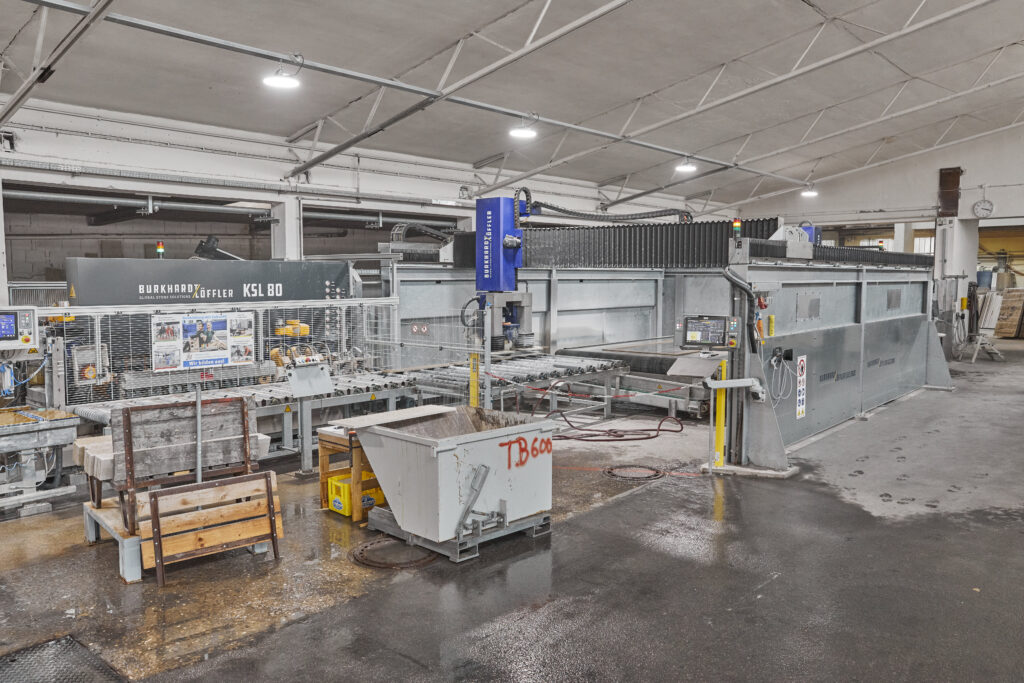
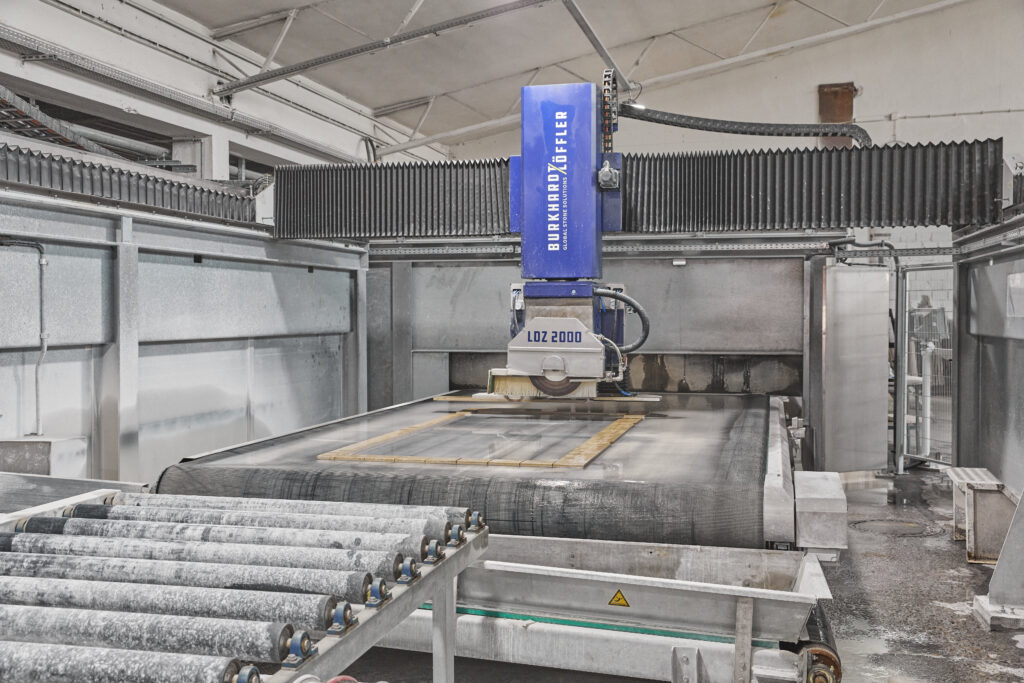
The new sawing station featuring the LDZ 2000 increases capacity. The fully automatic 5-axis bridge saw is also designed to produce more complex slab geometries, including kitchen worktops and polygonal stair treads. After cutting, another LDZ 2000 installed at this station lifts the cut pieces onto the roller conveyor, which transports them directly to the KSL 80 for edge processing. Finally, the saw reduces the offcuts remaining on the worktable into smaller pieces and automatically discharges them via the roller conveyor into a waste container.
The system’s high degree of automation has not only increased throughput but, above all, relieved employees of the physically demanding work involved in handling workpieces and offcuts.

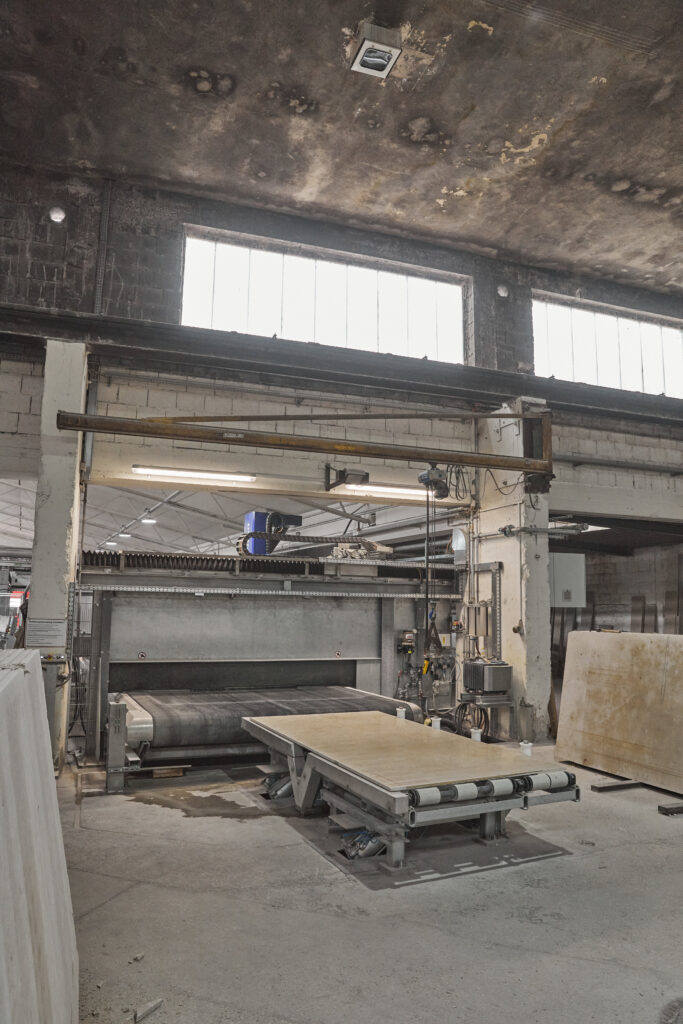
Loading station with tilting table and slab detection upstream of the new LDZ 2000 saw line
In operation: LDZ 2000 5-axis bridge saw with automatic tool changer and vacuum-assisted separation
At the end of the line: The KSL 80 edge polisher operates with eight vertical-face grinding heads and three upper and three lower chamfering heads, each equipped with an automatic scanning system.
The fully automatic sawing station is designed for a maximum capacity of 150–250 m² per day.
An LDZ 2000 with vacuum-assisted separation unloads cut pieces from the saw conveyor and reduces waste strips into smaller sections.

QUICK INFORMATION

Reading the Layers

Depending on the location of a Jura limestone quarry, it may contain more than 30 individual layers. The layer known as the metre bed forms the base of every quarry. Below it, there are no horizontal deposits considered economically viable for extraction. Layer 19, which is easily identifiable by its dark marl bands, is also present in every quarry. Count down another two layers and you reach Layer 17, a vividly structured stone that is particularly popular with architects.

Richard Watzke M.A.

is a trained stone sculptor and art historian. As a freelance editor, he publishes articles on natural stone extraction, processing technology and applications. His other areas of expertise include photography, marketing and public relations for stonemasonry companies, trade associations and institutions.

Naturstein Magazine 09 | 2024